
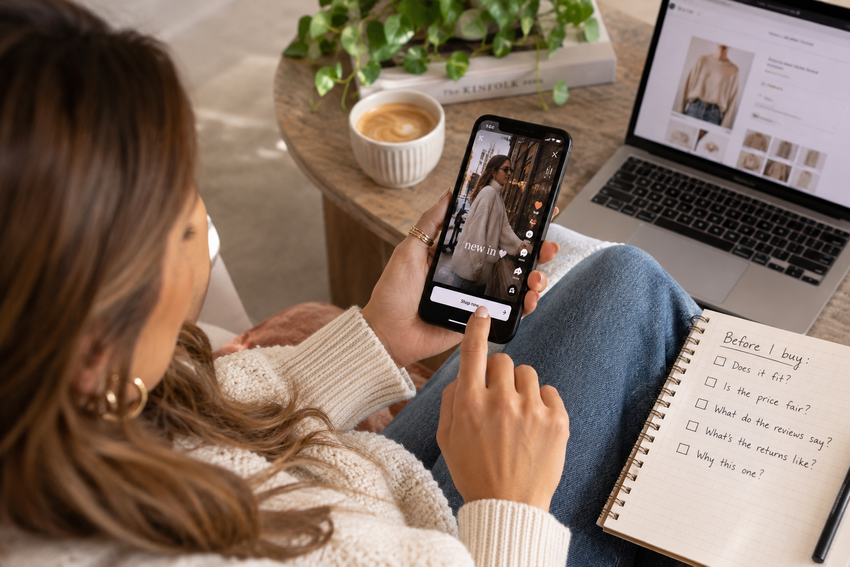
Short answer: shoppers now build confidence over several steps before they buy. They discover products on social, research them through search and AI tools, compare prices, check reviews and ask friends. For retailers, that means winning the sale depends on what happens before the till, not just at it.
That is the headline from Snapchat’s new report, The New Rules of Retail Growth, which looks at how retail, apparel and beauty shoppers discover, evaluate and buy. It is written for advertisers, and much of the research is US-based and commissioned by Snap, so treat the numbers as a signal rather than a UK benchmark. But the behaviour it describes will feel familiar to anyone running a shop, and it has real implications for how you buy, merchandise and market.
Price still matters. Four in 10 consumers are deal-driven or cost-conscious, according to Deloitte, but the report argues that up to 40% of a brand’s value comes from things beyond price, including quality, convenience, service and the shopping experience.
How do shoppers discover products now?
Mostly on social, and mostly through other people. In research Snap commissioned, 81% of Snapchatters said social channels give them ideas on what to shop for, and 85% said they find new products and brands through social ads and content. Friends and family are the strongest influence of all: 61% rank them as their most influential source, and 85% of Gen Z and Millennials involve friends somewhere in their shopping journey.
What it means for you: your next customer may well meet your product in a friend’s feed before they ever meet your shop. Stock that looks good, tells a story and is easy to talk about travels further.
Why do shoppers research so much before buying?
Because the journey now has more steps, and more tools. The report maps it as discover, research, compare, build confidence, then buy. Along the way, IBM and the National Retail Federation found that 41% of consumers use AI to research products, 31% use it to find deals and 33% use it to summarise reviews.
What it means for you: AI tools and search engines are reading your product pages, buying guides and reviews. If your website copy is thin, your products are harder to find and easier to overlook. Clear descriptions, honest sizing and fit information, and visible reviews all help.
What do shoppers want to know before they buy?
The report boils it down to five questions: does it fit, is the price fair, is there proof, what are the returns like, and why this one over another? Here is the useful part for independents. The report cites a meta-analysis of around 450 studies suggesting that what an ad says drives roughly half of its sales effect, while targeting accounts for about a tenth. In other words, answering those five questions beats being clever with audiences.
What it means for you: run your own check. Take your best seller and ask whether your social posts, product page and in-store signage answer all five questions. Most retail accounts, according to the report, answer one or none.
Why does a consistent story matter?
Because every change in message makes a shopper start again. If your Instagram post promises one thing, your product page says another and your reviews say something else, they have to rebuild their confidence before buying. The report suggests choosing one hero product and one proof point, such as a standout review, and repeating it everywhere. It also notes that social commerce is forecast to pass $100 billion in US sales in 2026, growing about twice as fast as online shopping overall.
Is it worth spending on people who already know you? Not all of it. In Haus’s regional tests, quoted in the report, brand-name search was the only ad type that lost money, returning about 70 cents in extra sales for every dollar spent. The exception is when competitors are bidding on your name - if you run paid ads, check how much goes on people who were already coming to you.Don’t judge a new channel too quickly
Another finding worth knowing: in tests run around Cyber Week 2025, 41% of the sales a campaign drove arrived after the ads had stopped. Brands that added awareness-building activity to an all-conversion plan improved total return on ad spend by about 90%, while those that pulled back to conversion-only lost roughly 40%. The report’s advice is to agree your success measures and decision date before you start, and to keep measuring for two to four weeks after a campaign ends.
What should UK retailers do next?
- Audit one hero product from first post to checkout and note where the message, price or proof changes.
- Answer the five questions (fit, price, proof, returns, why this one) in your content.
- Collect and show reviews. They feed both shoppers and AI tools.
- Stock products with a story, ones customers will want to show a friend.
- Set your success measures first before testing any new channel.
See what shoppers will be talking about next: Discovery starts long before the till, and so should your buying. Spring Fair 2027 runs from 7 to 10 February at the NEC Birmingham, bringing together more than 1,500 suppliers across home, gift and fashion. It is the place to find the products that will earn their place in your customers’ feeds, and to talk directly to the brands behind them.
FAQs
How do shoppers decide what to buy in 2026? They discover products on social media and through friends, research them using search and AI tools, compare prices, and check reviews before buying.
How many shoppers use AI to research products? IBM and the National Retail Federation found 41% of consumers use AI to research products, 31% to find deals and 33% to summarise reviews.
What matters more in advertising, targeting or the message? According to the report, creative drove about half of ad-attributable sales effect across roughly 450 studies, compared with about a tenth for targeting.
Does this research apply to UK retailers? Much of it is US-based and commissioned by Snap, so use it as direction rather than exact UK data. The underlying behaviour of researching, comparing and asking friends is widely visible in UK retail too.
For more practical retail insight, visit Inside Retail or sign up to the Inside Retail newsletter.