
)
Fashion is the most challenged sector in independent retail right now. That's not an opinion, it's what the data says. The Voices of Retail 2026 report, which surveyed 650 UK retailers and 2,040 consumers in Q1 this year, found that while 33% of fashion retailers are growing, 36% are declining. The only sector where more businesses are going backwards than forwards.
So let's start there. Not with the reassurance, but with the reality. Because the boutiques that are winning against fast fashion aren't doing it by accident, or by ignoring how hard the market is. They're doing it by making very specific, very deliberate choices that the data now backs up clearly.
The findings come from the Voices of Retail 2026 report, research that will shape the agenda at Autumn Fair this September, where independent fashion retailers gather to source, connect, and hear from the people defining what's next for the sector.
The trap most struggling boutiques are falling into
The Voices of Retail report identifies one strategy that reliably separates growing retailers from declining ones, and one that reliably makes things worse.
The strategy that makes things worse? Pivoting to cheaper products. Forty-five per cent of declining retailers are doing exactly that; cutting prices, moving downmarket, trying to compete with fast fashion on its own terms. It doesn't work. And the consumer data explains why: only 18% of shoppers cite discounts and sales as a loyalty driver. The report calls this out directly as a trap, retailers "optimising for the thing their customers care least about."
The strategy that works? Brand storytelling. Growing retailers are nearly twice as likely to invest in communicating who they are and what they stand for, 39% of growing retailers vs just 20% of declining ones. That's a 19 percentage point gap, the single largest differentiator in the entire dataset.
The irony is that brand storytelling is also one of the industry's most underused strategies overall. Only 30% of all retailers surveyed are actively investing in it. Which means the opportunity is hiding in plain sight.
What consumers are actually telling you
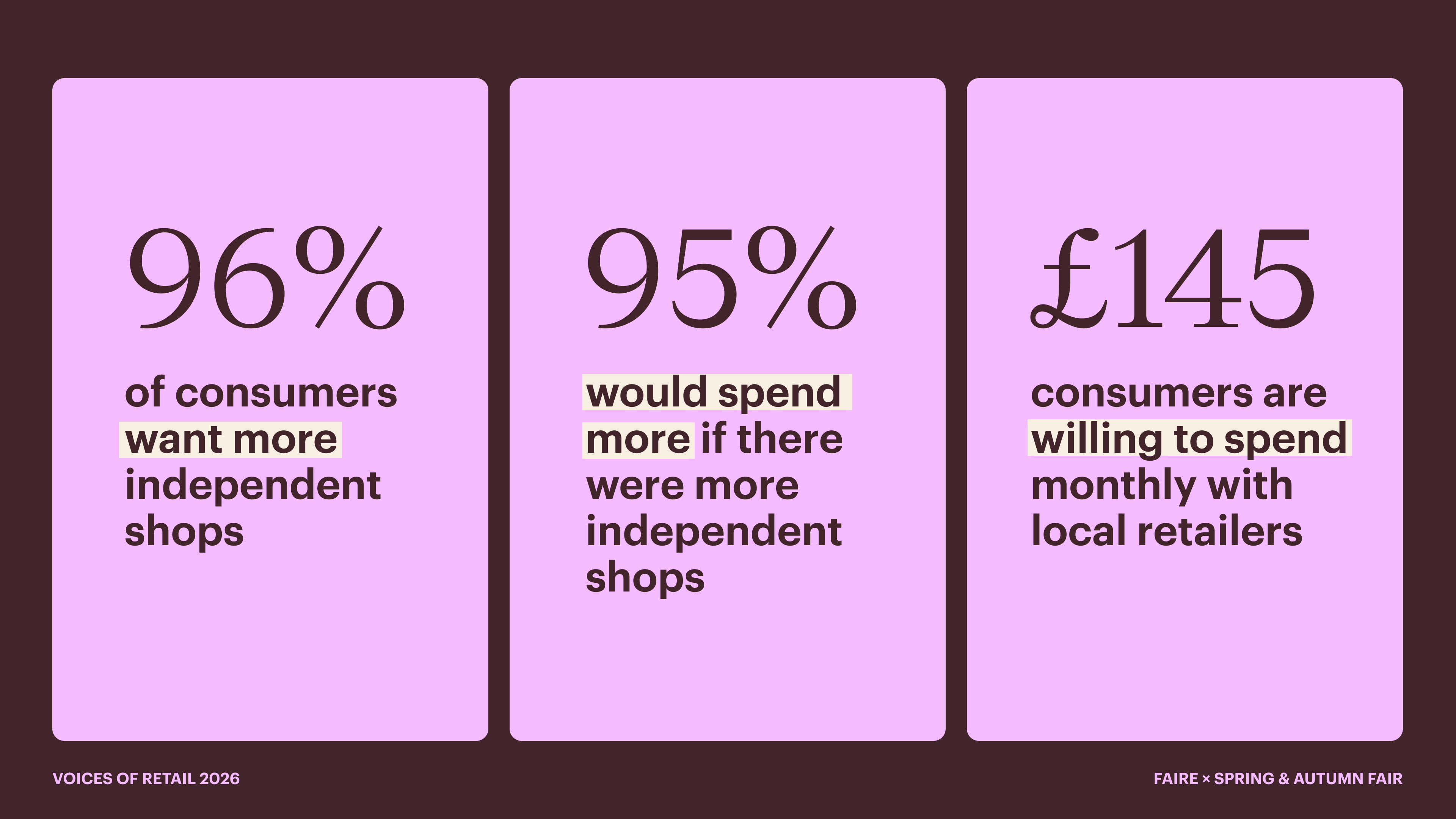
The consumer side of the Voices of Retail report is, if anything, even more striking. This is 2,040 UK shoppers, surveyed in March 2026, telling you directly what they want and why they choose you.
Sixty-one per cent choose independent shops for personality. Eighty-two per cent say they get a better experience with independents than chains. Eighty-five per cent would prefer to spend with local businesses over corporations. Ninety-six per cent want to see more independent shops on their high street.
And here's the number that should be on every boutique owner's wall: 95% of consumers say they would spend more if there were more independent options.
The demand isn't the problem. The supply of compelling independent retail is. The £145 per month that consumers say they're willing to spend with local retailers represents a substantial pool of spending that exists and is looking for somewhere to go.
When 47% of shoppers say they choose independents because they want something unique they can't find elsewhere, that's a direct brief for how to buy. Exclusivity, curation, and character are not nice-to-haves. They're the reason your customer walked through the door instead of opening another browser tab.
The AI tailwind you might not have seen coming
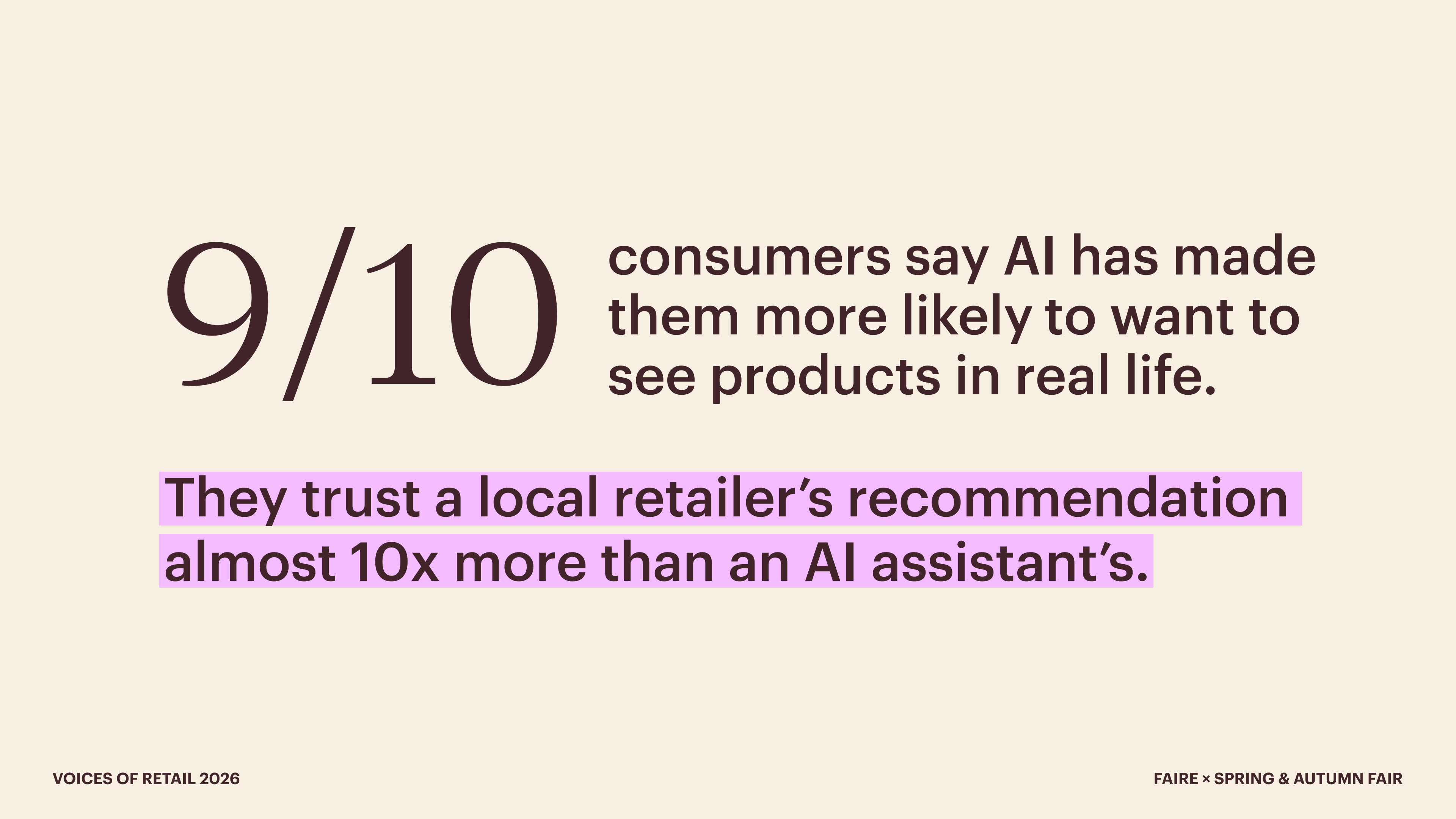
Here's a finding that reframes the competitive conversation entirely. Nine in ten consumers surveyed say that AI actually makes them more eager to see products in person and speak with a real expert. The more algorithmic retail becomes, the more valuable human expertise gets.
And the report quantifies that trust gap precisely: a local retailer recommendation carries ten times more weight than an algorithm's. Eighty-one per cent of consumers trust local retailer recommendations. Eight per cent trust an AI assistant.
Fast fashion's competitive advantage is scale, data, and speed. But what it can't manufacture is the credibility of someone who has curated a rail with genuine knowledge and taste. The boutique owner who knows their customer, who has handled the fabric, who understands why this label works for this shop and not that one. That expertise is increasingly rare, increasingly valued, and increasingly hard to replicate.
What's actually driving loyalty
The Voices of Retail data is equally clear on what keeps customers coming back. Quality products (65%), good value (62%), and excellent service (61%) are the top three loyalty drivers. These are not flashy differentiators, they're the fundamentals. But they're fundamentals that a small, expert, personally invested team delivers more consistently than a fulfilment warehouse ever can.
The in-store advantage compounds over time. Forty-two per cent of consumers already have a favourite independent retailer they return to. Forty-six per cent say they choose retailers that drive a sense of community. The relationship between a boutique and its regulars is not just a nice feature of independent retail, it's the primary mechanism of retention that fast fashion simply cannot match at a local level.
The growth profile that should encourage you
One of the sharpest findings in the Voices of Retail report concerns which retailers are growing fastest, and it's not who you might expect. The fastest-growing retailers are not the most established. They're the newest. Businesses trading for one to three years are growing at twice the rate of those who've been operating for a decade or more.
The energy, according to the data, is at the edges of the sector not the middle. This matters for independent boutiques because it suggests the market rewards momentum and distinctiveness more than longevity and safety. Retailers who are building something clear, communicating it well, and sourcing with intention are outperforming those who are staying the course.
Twenty-eight per cent of retailers are actively investing for growth right now, despite cost pressures. A further 33% are experimenting and adapting as opportunities arise. The boutiques navigating this market best aren't waiting for conditions to improve before they make moves — they're making them now, using fashion trade shows and apparel sourcing events to find the products and suppliers that serve a clearly defined customer, and building the brand story that turns first-time visitors into loyal regulars.
The opportunity in front of you
The Voices of Retail report closes with a line worth sitting with: "Britain's retailers and shoppers want the same thing: a high street with character, expertise, and a reason to show up. The only thing missing is more of it."
Fashion is the most challenged sector. But the fundamentals that make a great boutique — curation, expertise, personality, community — are exactly what consumers say they're looking for and will pay for. The data is unanimous on the demand side. What it now makes clear is that the supply side needs to stop competing on price and start competing on the thing it's already winning on.
Explore more on buying strategy, sourcing, and retail trends across fashion, gift, and interiors on the Inside Retail hub.
If you like what you've seen here, why not join us in-person for the retail event of the season. Enjoy live content sessions from some of the biggest names in the industry, and get up close and personal with the products that will be shaping our industry in the year to come.